Double Dip - 7/27-7/31/26
On July 27, after camping several days in Scotia Canyon in the Huachucas and out of cell phone service, we drove over to the east side of the mountains headed for a planned stay of another several nights in Rucker Canyon in the southern Chiricahua Mts.
When we emerged from the cellular blackout that is the canyons of the Huachucas, we immediately got several messages - direct and via Discord - that an Eared Quetzal had been recorded that morning in the South Fork of Cave Creek Canyon. The audio was indisputably an Eared Quetzal. Although we had seen this species in 2020, it was a bird we really wanted to see again, so instead of going to Rucker, we drove directly to South Fork.
We arrived at South Fork at about 4 pm, and immediately hiked back to the area just past the 2nd creek crossing where the bird had been recorded and staked out the area, picking a spot where the canyon was narrow with the idea that if the bird moved through the area, that would offer the best chance at seeing it. Several other birders were in the area, and we had high hopes. Although we sat for 3 hours and were in the canyon until almost dark, no one observed or heard the bird that afternoon. See checklist: eBird Checklist - 27 Jul 2026 - Cave Creek Canyon--South Fork - 21 species
The morning of 7/28, we arrived at the trailhead in the predawn, at 0525. We again hiked back to the area, eventually staking out the third crossing. We sat for 6 hours before hiking out. Lots of good birds, but no Eared Quetzal. See checklist: eBird Checklist - 28 Jul 2026 - Cave Creek Canyon--South Fork - 35 species
With no sightings since the original one, we decided to resume our planned schedule, and go back to Rucker. Eared Quetzal sightings can be fleeting, and if a bird hasn't established a pattern, they can be in one spot one day, and on the other side of the mountain the next. In fact, the day we say the bird in 2020 at Herb Martyr it had been seen at Pinery Canyon that same morning before returning to roost at Herb Martyr that evening.
However, a few hours after we got out camp set up in Rucker, another birder arrived and told us that the quetzal had been recorded vocalizing less than 100 yards from our stakeout site - about 30 minutes after we had given up! Since we were already camping in Rucker, we decided to bird the next morning in Rucker before heading back to South Fork that next afternoon.
The afternoon of 7/29 saw most of the mountains getting a substantial rain. We arrived at about 3 pm, sat out the rain and then headed up the canyon and birded until dark. We did see quite a few Coppery-tailed Trogons, but no quetzal. See checklist: eBird Checklist - 29 Jul 2026 - Cave Creek Canyon--South Fork - 20 species
On 7/30, we arrived at the trailhead at about 0630, then hiked up determined to sit through the middle of the day - this was a direct response to having given up a little short on 7/28. So we sat at the "bathtub" (4th crossing) for an 8-hour stakeout. Again, no quetzal. See checklist: eBird Checklist - 30 Jul 2026 - Cave Creek Canyon--South Fork - 34 species (+1 other taxa)
We drove out of the canyon to make some phone calls (in the midst of a refi on the house - had to contact the mortgage company). By the time we got those calls completely, then drove back to the Portal Store planning on getting a pizza. As we pulled in and got WiFi, I saw in my alerts that there was a Blue-black Grassquit currently being seen at Triangle Pond in Buenas Aires NWR - unfortunately over 3 hours away! Had I checked eBird immediately upon leaving the canyon, we'd have had time to make the drive before dark . . . as it was, there was no way to make it there before sunset. But Lifers take precedence over cool "year birds", so we broke camp and drove that direction. We ended up sleeping in the car just west of Arivaca - it was extremely hot and humid and one of the most miserable nights camping we've had. But the bird had been present until sunset, and we had high hopes that it would be present again at first light.
On 7/31, we arrived at Triangle Pond a bit later than planned - about 15 minutes after first light. Birders already on the scene had not yet relocated the bird. The crowd slowly increased, but the bird never showed. I assume that it left the site at first light and went un-observed. We stayed for 7.5 hours, well into the heat of the day in the hopes that - since the bird was first detected at 11 am the previous day - the bird would return for water sometime during the hottest part of the day. It did not. See checklist: eBird Checklist - 31 Jul 2026 - Buenos Aires NWR--Triangle Pond - 37 species (+2 other taxa)
So we dipped. Twice. First primarily because we gave up 30 minutes too early on the Eared Quetzal. Second, mostly because we stubbornly refused to give up on the quetzal and we stayed in the canyon long enough that we weren't able to make the drive for the Grasssquit while it was still being seen that night. But dipping is part of chasing rarities.
|
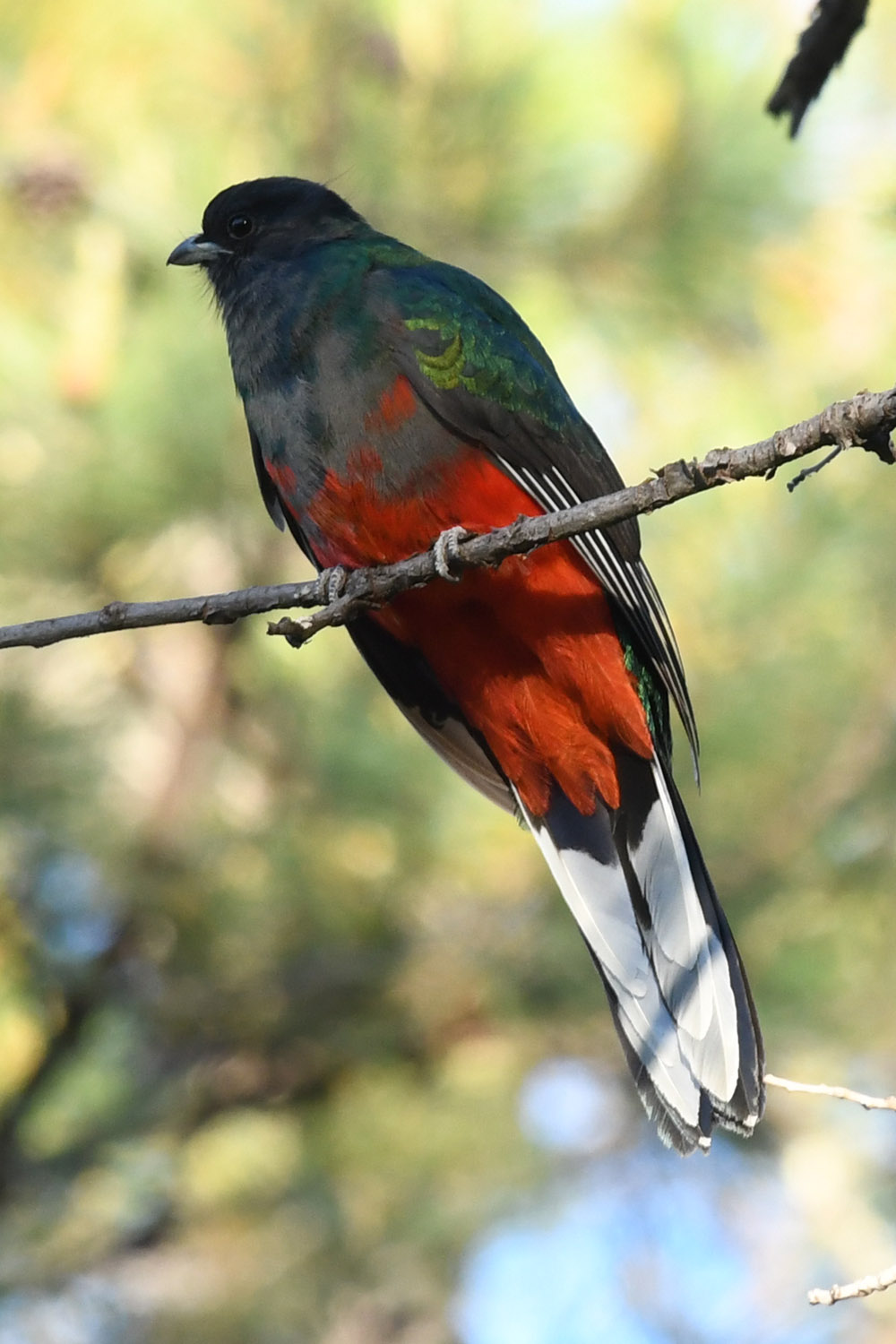
Eared Quetzal that we did see in 2020
Blue-black Grassquit from 7/30 that we didn't see on 7/31
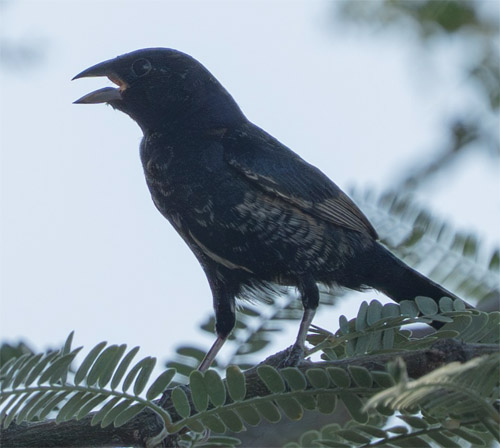
photo by Ken Murphy
|


 |